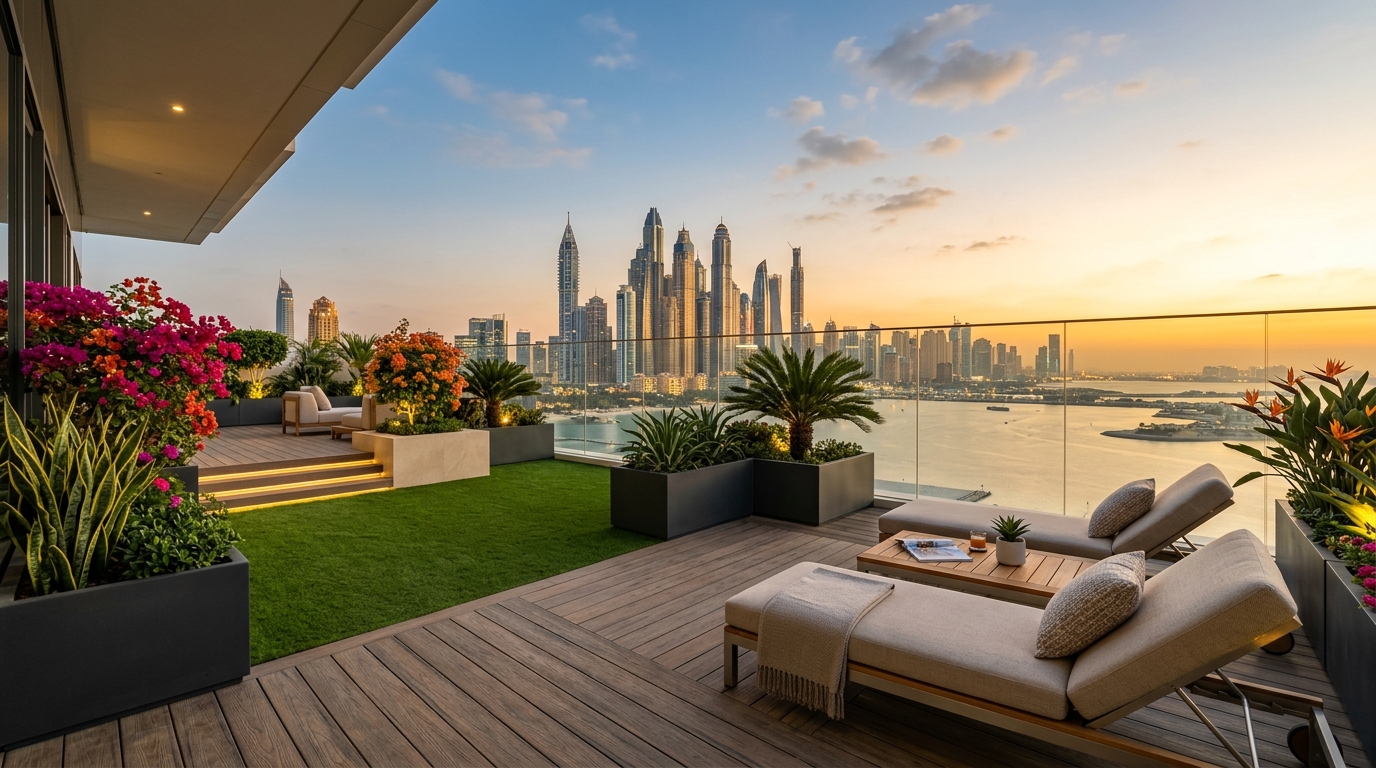
For residents of high-rise penthouses and luxury apartments across Dubai Marina, Jumeirah Beach Residence (JBR), Downtown Dubai, and Business Bay, the private balcony or rooftop terrace represents invaluable outdoor real estate. However, transforming a windswept, sun-bleached concrete slab into an oasis of lush greenery requires addressing harsh microclimate conditions that ground-level villa gardens never encounter.
At heights exceeding 50 to 150 meters, plants must withstand sustained wind shear, severe thermal reflectance from floor-to-ceiling glass facades, strict building management (HOA) regulations, and rigid structural weight thresholds. Without methodical engineering, improvised balcony gardens frequently suffer from desiccated foliage, cracked pots, and catastrophic water seepage down the building facade.
Architectural Summary: The 4 High-Rise Ground Rules
- Load-Bearing Compliance: Always verify that saturated planter weight remains below the building slab structural capacity (typically 200–300 kg/m2).
- Zero Water Runoff: Install closed-loop internal reservoirs and overflow catch trays to avoid staining building exteriors or dripping onto lower units.
- Wind Resistance: Select flexible-stemmed, low-surface-area flora and anchor tall architectural planters to prevent wind toppling.
- Solar Glare Defense: Position reflective thermal insulation barriers inside planter walls to protect root systems against midday glass heat.
1. Structural Weight Engineering: Calculating Balcony Dead Loads
The single most critical engineering parameter in high-rise landscaping is structural load-bearing capacity. Standard residential towers in the UAE are engineered to British Standards (BS EN 1991) and Dubai Building Code requirements, providing residential balconies with live load limits between 2.0 kN/m2 and 3.0 kN/m2 (approximately 200 to 300 kilograms per square meter).
Homeowners often underestimate the density of water-saturated soil. A standard terracotta or concrete pot filled with traditional red sweet sand and soaked with water can easily exceed 400 to 500 kg/m2, creating severe structural safety hazards and violating building insurance policies.
| Planter Material | Empty Shell Weight (100x40x50cm) | Substrate Type Used | Total Saturated Weight | Safety Verdict |
|---|---|---|---|---|
| Cast Concrete / Stone | 65 – 85 kg | Natural Sand & Clay Mix | 320 – 390 kg | Hazardous / Non-Compliant |
| Glazed Ceramic / Terracotta | 45 – 60 kg | Standard Potting Soil | 220 – 280 kg | Borderline / Heavy |
| Marine-Grade GRP Fiberglass | 12 – 18 kg | Engineered Perlite & Coir | 75 – 110 kg | Certified Safe & Optimal |
To ensure 100% building compliance, Yad Al Ma manufactures custom Glass Reinforced Plastic (GRP) planters. GRP offers high tensile strength, UV stabilization against 50°C summer heat, and thermal insulation, while reducing empty container weight by more than 75% compared to concrete. Furthermore, we substitute heavy garden dirt with specialized horticultural substrates formulated from washed coconut coir, perlite, and volcanic pumice, achieving maximum water retention at a fraction of the weight.
2. Microclimate Dynamics: High-Altitude Winds & Glass Reflection
The microclimate on an 18th-floor balcony differs drastically from ground-level conditions. Two dominant atmospheric forces govern high-rise plant survival in the UAE:
A. Wind Desiccation & Shear Force
Wind velocity increases significantly with elevation. Strong air currents rapidly strip moisture from leaf stomata via transpiration, inducing severe water stress even when the root ball is moist. Rigid, large-leaved tropical plants like standard banana palms or broad philodendrons will shred and collapse within days of exposure to high-altitude winds.
B. Architectural Glass Heat Amplification
Modern Dubai towers utilize Low-E reflective double-glazed windows designed to reflect solar radiation away from interiors. This reflected thermal energy is concentrated directly onto the balcony floor, raising ambient temperatures to 55°C–60°C during summer afternoons. Uninsulated pots absorb this heat, effectively baking root systems. Our dedicated balcony and penthouse terrace landscaping service integrates double-walled internal thermal barriers to protect root structures from heat shock.
3. Curated Botanical Palette: What Thrives on Dubai Balconies
Selecting flora for high-rise terraces requires choosing wind-acclimatized, drought-resilient, and sun-loving specimens that maintain lush foliage year-round.
Top 6 Proven Plant Varieties for High-Rise Dubai Terraces
- Bougainvillea Spectabilis: The undisputed champion of UAE balconies. Produces vibrant magenta, white, or orange bracts, loves full sun, and features pliable branches that flex effortlessly in strong winds.
- Sansevieria Trifasciata (Snake Plant): Indestructible architectural foliage. Withstands low watering, extreme heat, and harsh winds without leaf burn. Perfect for modern perimeter borders.
- Strelitzia Reginae (Bird of Paradise): Architectural elegance with leathery, paddle-shaped leaves that resist wind tearing. Provides tropical luxury near sheltered balcony alcoves.
- Phoenix Roebelenii (Pygmy Date Palm): A compact, slow-growing palm cultivar that delivers resort-style ambiance without exceeding weight limitations or outgrowing balcony ceiling heights.
- Carissa Macrocarpa (Natal Plum): Dense, glossy emerald green leaves with fragrant star-shaped white blossoms. Salt-spray and wind tolerant, making it ideal for Dubai Marina and Palm Jumeirah coastal balconies.
- Agave Attenuata (Fox Tail Agave): Spineless, architectural blue-green succulent rosettes that thrive in full sun and reflected glass heat with minimal water demands.
4. Spill-Free Automated Micro-Drip Irrigation Engineering
One of the fastest ways to receive a violation notice from Dubai building management is allowing dirty irrigation runoff to cascade down the building facade or drip onto neighboring balconies. Hand watering with a watering can is prone to human error, resulting in either under-hydrated plants or flooded balconies.
Yad Al Ma engineers custom automated micro-drip networks tailored to each terrace. Using pressure-compensating drip emitters calibrated to 2 liters per hour, water is delivered directly into the root zone via concealed UV-resistant micro-tubing. If an outdoor water outlet is available, we install a smart Bluetooth/WiFi timer with an anti-siphon backflow preventer. For apartments lacking external taps, we conceal an automated closed-loop reservoir inside an architectural planter, providing up to 21 days of autonomous watering.
Crucially, all our planters feature elevated internal drain wells and sealed drainage catch trays. Excess moisture is retained safely within the sub-base for re-absorption via capillary wick action rather than escaping onto the floor tiles.
5. Terrace Decking, Privacy Screening & Ambient Lighting
True luxury terrace design extends beyond planters to encompass the entire outdoor living environment:
- WPC Composite Decking: We install elevated wood-plastic composite (WPC) decking on adjustable polypropylene pedestals. This allows rainwater and air to flow freely beneath the deck while creating a warm, barefoot-friendly surface that stays 15°C cooler than bare porcelain tiles.
- Architectural Privacy Screening: Laser-cut aluminum screens powder-coated in matte bronze or anthracite provide acoustic separation from neighboring apartments and shield lounging areas from wind gusts.
- Low-Voltage LED Mood Lighting: We integrate 12V IP67 waterproof warm LED strip lighting beneath planter kickboards and recessed uplights into specimen trees, creating an inviting nighttime lounge overlooking the city lights.
Ready to Transform Your Dubai Penthouse Terrace?
Book a complimentary on-site structural load assessment and 3D concept review with our senior high-rise urban landscape team.